Important Notice: Beware of Scams Using the Name "EINPAYS/EINPAYZ"
We have recently discovered that fraudsters are misusing the name EINPAYS/EINPAYZ to deceive traders, service providers, and other individuals by collecting payments through unauthorized channels.
- If you receive any communication claiming to be from EINPAYS/EINPAYZ and asking for payments or sensitive details, we strongly urge you to verify its authenticity first.
- All the official contact details can be found on https://einpays.com or https://einpayz.com
Verify Before You Act:
To confirm whether a communication is genuinely from EINPAYS/EINPAYZ, please email us at [email protected] before making any payments or sharing any personal information.


Become a Partner
Do you want to become a partner
Your name
Fill the form to submit
Your Company name
Fill the form to submit
Your E-mail
Fill the form to submit
Countries
Fill the form to submit
Your phone number (Telegram)
Fill the form to submit
Web-site
Fill the form to submit
Contact person
Fill the form to submit
Business

Message
Fill the form to submit
Become a Partner
Do you want to become a partner
Your name
Fill the form to submit
Your Company name
Fill the form to submit
Your E-mail
Fill the form to submit
Countries
Fill the form to submit
Your phone number (Telegram)
Fill the form to submit
Web-site
Fill the form to submit
Contact person
Fill the form to submit
Business
Message
Fill the form to submit
Crypto portfolio has dropped significantly: what to do step by step
- 2026-08-26
A sharp crypto market decline can easily trigger the urge to do something immediately: sell everything or, on the contrary, buy even more. But the first thing to do after a major drop is not make a trade, but pause and analyze. It is important to understand the reason for the decline, assess the condition of your assets, and determine whether the current level of risk is consistent with your financial situation. In short: first, assess the current state of your portfolio, identify the reason for the decline, review your financial obligations, and only then decide whether to leave things unchanged, reduce risk, or gradually increase your position.
Step 1. Don’t try to recover your losses immediately
After a significant drop, it is easy to act emotionally: start buying without a plan, use leverage, or follow questionable advice. That is why the first step should be to pause. The exception is margin and futures positions, where there is a risk of liquidation. These should be checked separately. Also make sure the decline is actually market-related and not caused by an account security issue. Unknown logins, changed account details, or withdrawal problems require immediate investigation. FINRA (Financial Industry Regulatory Authority) notes that crypto assets can involve high volatility and limited liquidity, meaning the risk of significant losses remains high.
Step 2. Identify the reason for the decline
If most major crypto assets are falling, it is likely a broader market movement. If one token is falling significantly more than others, look for issues specific to the project: a hack, changes to tokenomics, declining liquidity, or other negative developments. Another scenario is a problem with an exchange or wallet. Withdrawal restrictions or a compromised account are not ordinary market declines. That is why you should look not only at your total balance but also at how much each position contributes to the overall loss.
Step 3. Calculate the size of the drawdown
Record:
- the current value of each position;
- its share of the portfolio;
- the average purchase price;
- the current drawdown;
- where the asset is stored;
- the original reason for buying it.
Also separate money you will need in the near future and any borrowed funds.
There is an important principle: −20% → requires +25% to recover −50% → requires +100% −80% → requires +400% So simply expecting the price to “come back” is not always a realistic strategy.
Step 4. Reassess every asset
Ask yourself the key question: Would you buy this asset today at its current price? Check whether the project’s product, team, security, liquidity, and tokenomics have changed. A red chart does not prove that an asset should be sold. But hoping for a recovery is not evidence of future growth either.
Step 5. Assess your risk concentration
A 50% drop in an asset that represents 10% of your portfolio and a 50% drop in an asset that represents 70% of your portfolio are two completely different situations. That is why it is important to look not only at the number of coins you hold, but also at their allocation and correlation. Holding several tokens does not automatically mean you have a well-diversified portfolio. The key question: how would another major decline affect your financial plans?
Step 6. Choose a strategy
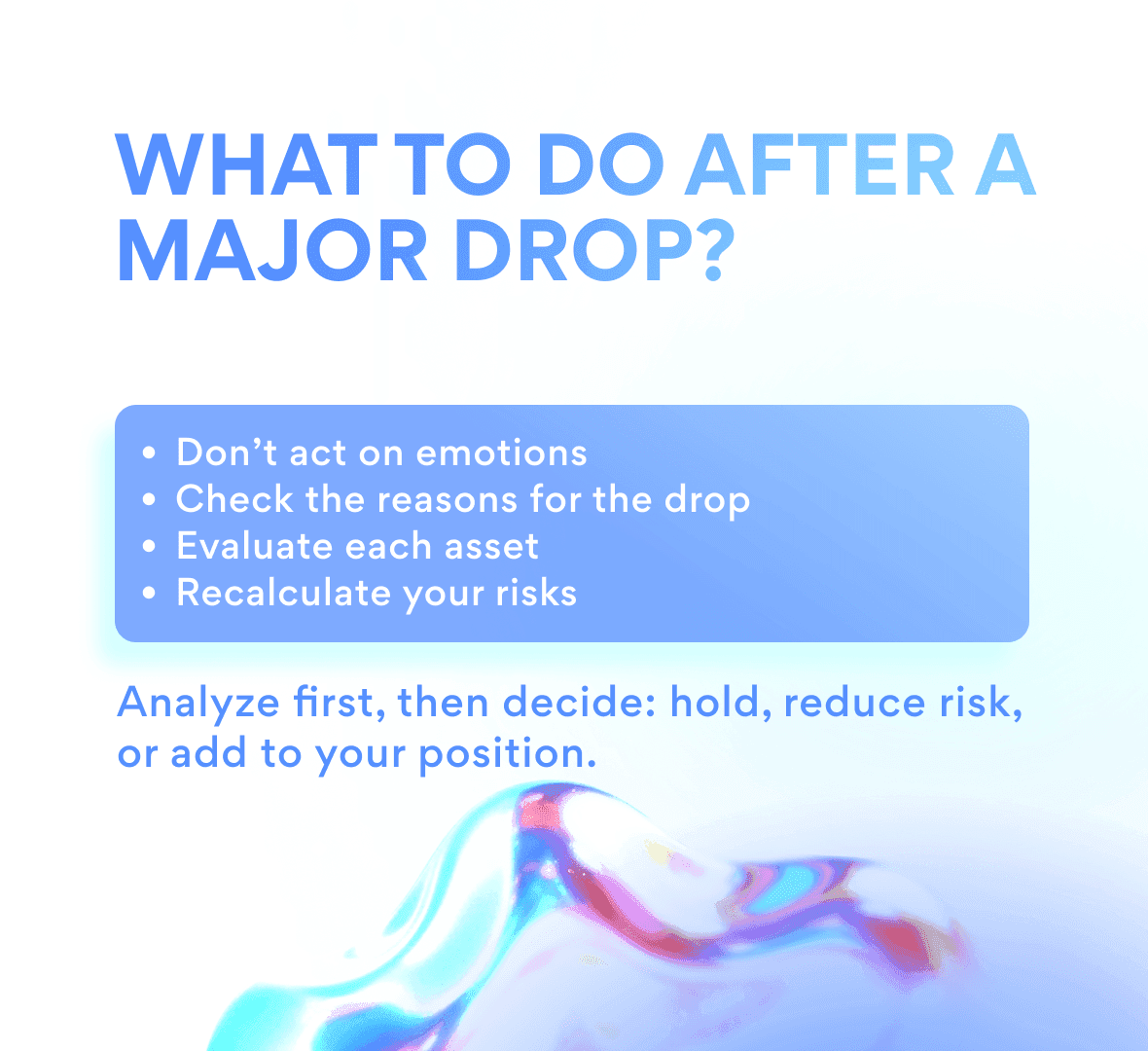
After analyzing the situation, there are usually three options:
- Do nothing. If your original investment thesis remains valid, you don’t need the money in the near future, and the risk remains acceptable.
- Reduce risk. If one position has become too large or serious negative factors have emerged.
- Add funds. Only if, after reassessing the asset, it still fits your strategy. Determine the amount and maximum risk level in advance.
**Averaging down does not fix a bad asset — it only increases your position. **
Plan for the next 72 hours
- Pause — don’t make decisions based on fear.
- Security — check your accounts and access to your funds.
- Numbers — calculate allocations, losses, and financial obligations.
- Analysis — distinguish a broader market decline from problems specific to individual assets.
- Plan — define the conditions for keeping or reducing each position.
- Risk limit — set a maximum amount you are willing to allocate to crypto assets in advance.
A major drawdown is not automatically a signal to buy or sell. It is an opportunity to reassess your portfolio and regain control over your risk. First, understand the reasons behind the decline, assess your assets and financial situation. Only then make a decision.
A good plan is not about trying to predict the bottom. It is about being able to control risk when the market moves against you.
Other News
Crypto acquiring: a solution or a new headache?
23.09.2026
Crypto acquiring: a solution or a new headache?
Cryptocurrency is used for more than just investing. Today, digital assets are also used for transfers, international settlements, and payments for goods and services. For businesses, this creates new opportunities while also introducing additional risks. That is why crypto acquiring should not be viewed as a universal solution, but rather as a tool that needs to fit a specific business model.
What is settlement: payment cycles and settlement timelines
16.09.2026
What is settlement: payment cycles and settlement timelines
A customer has paid for an order and received a “Payment successful” message, but the merchant still doesn’t see the funds in their bank account. This doesn’t necessarily mean there is an error. A successful payment and the actual receipt of funds are two different stages. Between them come processing, verification, clearing, and settlement — the process of settling the payment. Understanding this process helps businesses manage cash flow, reconcile orders, and know when funds actually become available.

How digital payments help Indian businesses grow online
09.09.2026
How digital payments help Indian businesses grow online
Indian businesses are rapidly moving into the digital space. Companies sell through websites, mobile apps, social media, messaging platforms, and marketplaces. For businesses, this creates an opportunity to reach customers far beyond their local region. But online sales are impossible without convenient payment options. If a customer cannot complete a purchase quickly and securely using their preferred payment method, a company risks losing that customer before the order is even placed. That’s why payment infrastructure is becoming more than just a technical tool — it is now part of a company’s growth strategy.


Connect global

Sales
Business Development Manager
Partnership
Account Manager
Business Development Manager
Connect global
Sales
Partnership
Account Manager
Business Development Manager
Business Development Manager


Become a Partner
Do you want to become a partner
Your name
Fill the form to submit
Your Company name
Fill the form to submit
Your E-mail
Fill the form to submit
Countries
Fill the form to submit
Your phone number (Telegram)
Fill the form to submit
Web-site
Fill the form to submit
Contact person
Fill the form to submit
Business
Message